AI PCs: What Are They?
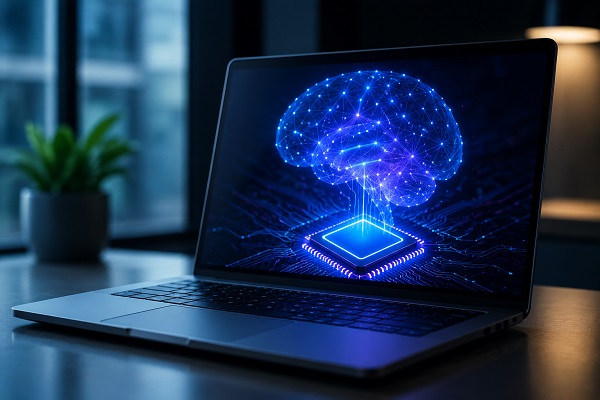
Artificial intelligence is becoming a bigger part of everyday technology, and computers are changing along with it. One of the latest developments in the PC market is the **AI PC**—a computer designed with dedicated hardware and software capabilities to handle artificial intelligence tasks more efficiently.
Unlike traditional computers that rely mainly on the CPU and GPU for processing, AI PCs typically include a dedicated **Neural Processing Unit (NPU)**. This specialized processor is designed to handle AI workloads while using less power than running the same tasks entirely on the CPU or GPU.
What Exactly Is an AI PC?
An AI PC is essentially a computer built to run certain artificial intelligence features directly on the device.
The main difference is the presence of dedicated AI-processing hardware, usually an NPU. The NPU can handle tasks such as image processing, voice recognition, background effects during video calls and other AI-powered functions.
Instead of sending every AI-related task to a cloud server, some workloads can be processed locally on the computer.
What Is an NPU?
NPU stands for **Neural Processing Unit**.
It is a processor specifically designed for AI and machine-learning workloads. While CPUs are designed for general computing and GPUs are particularly effective at graphics and highly parallel workloads, NPUs are optimized for certain AI calculations.
A simple way to understand it is:
* **CPU:** General-purpose computing
* **GPU:** Graphics and parallel processing
* **NPU:** AI and machine-learning workloads
These processors can work together rather than replacing one another.
Why Are AI PCs Becoming Popular?
The growth of generative AI has increased demand for computers capable of handling AI features more efficiently.
Modern users are increasingly using AI for writing, image editing, video creation, productivity, communication and other tasks. Manufacturers are therefore adding dedicated AI capabilities to new PCs.
AI features can also make everyday computing more convenient.
For example, an AI PC may support features that improve video calls, organize information, assist with content creation or automate certain repetitive tasks.
AI PCs Can Process Some Tasks Locally
One important advantage of AI PCs is **on-device AI processing**.
Traditional AI services often rely heavily on cloud computing. A user sends information to a remote server, the server processes it and the result is sent back.
With compatible AI applications, an AI PC can perform certain tasks locally.
This can provide several potential benefits, including faster response times, reduced dependence on an internet connection and improved privacy for some workloads because data does not necessarily have to leave the device.
However, not every AI feature can be performed locally. Large and computationally demanding AI models may still require cloud infrastructure.
Better Battery Efficiency
Another potential advantage is improved power efficiency.
AI workloads can consume significant processing resources when handled entirely by a CPU or GPU. A dedicated NPU can take over supported AI tasks and perform them using less power.
For laptop users, this could become particularly important.
More efficient AI processing can help manufacturers introduce AI-powered features without placing as much additional pressure on battery life.
The actual benefit, however, depends on the processor, software and type of workload.
AI PCs Are Not Just for AI Professionals
The term "AI PC" might sound like it is aimed only at developers, researchers or technology professionals.
That is not necessarily the case.
AI features are increasingly being integrated into everyday applications. Students, office workers, content creators and regular consumers may encounter AI-powered tools without needing to understand how the underlying technology works.
For example, AI can assist with:
* Video-call background effects
* Noise reduction
* Photo enhancement
* Writing assistance
* Image generation
* Transcription
* Translation
* Search and organization
* Productivity applications
The goal is to make AI capabilities part of normal computer usage rather than requiring users to open a separate AI service for every task.
AI PC vs Traditional PC
The biggest difference is dedicated AI processing capability.
A traditional PC can still run many AI applications. In fact, powerful CPUs and GPUs can handle significant AI workloads.
An AI PC adds specialized hardware designed specifically for AI tasks.
This does not mean every AI PC will automatically be faster than every traditional PC. A computer's overall performance still depends on its CPU, GPU, RAM, storage, cooling system and software.
The NPU is an additional capability rather than a replacement for all other processors.
Do You Need an AI PC?
Whether an AI PC is worth buying depends on how you use your computer.
For someone who mainly browses the internet, watches videos, works with documents and uses basic applications, an AI PC may not provide a dramatic difference today.
For users who regularly work with AI-powered applications, video conferencing, content creation or other compatible workloads, dedicated AI hardware can become more useful.
For people buying a new laptop today, however, AI capabilities may be worth considering because software is increasingly being designed around local AI processing.
What About Gaming?
AI technology is already important in gaming, particularly for graphics technologies and performance optimization.
However, an NPU does not automatically make a laptop a better gaming machine.
Gaming performance still depends heavily on the CPU and especially the dedicated GPU.
AI PCs may offer additional AI-related features, but gamers should continue to look at GPU performance, thermal design, display refresh rate, RAM and storage when choosing a gaming laptop.
The Future of AI PCs
AI PCs are likely to become increasingly common as operating systems and applications make better use of dedicated AI hardware.
Future computers could perform more tasks locally, from intelligent search and personal assistants to real-time translation, content creation and advanced productivity features.
The biggest change may not be the hardware itself but how software interacts with it.
Instead of treating AI as a separate application, future operating systems could make AI assistance a normal part of everyday computing.
Final Thoughts
AI PCs represent the next stage in the evolution of personal computers.
Their key feature is the addition of dedicated AI-processing hardware, particularly NPUs, which can handle compatible workloads more efficiently. They can potentially improve performance, power efficiency and privacy for certain AI applications while reducing dependence on cloud processing.
However, an AI PC is not automatically better for everyone. Buyers should still consider the fundamentals—processor performance, GPU capability, RAM, storage, display quality, battery life and overall price.
As AI becomes increasingly integrated into everyday software, though, **AI PCs are likely to become a standard part of the computer market rather than a niche category.**