Annual TReDS Financing Expected to Reach Rs 8-10 Lakh Crore by FY30 by CareEdge Ratings

Synopsis
• Annual TReDS financing is expected to reach ~Rs 8-10 lakh crore by FY30, supported by wider MSME and buyer participation, mandatory CPSE invoice routing and sustained financier appetite.
• Presently, platform-level TReDS seller registrations account for only around 0.30% of the combined Udyam and Udyam Assist Platform base, highlighting substantial headroom for wider MSME onboarding.
• Over 94% of uploaded invoice value receive funding, indicating strong and sustained financing availability for eligible buyer-accepted receivables and a sizeable growth opportunity for banks, NBFCs and TReDS platforms.
Overview of Trade Receivables Discounting System
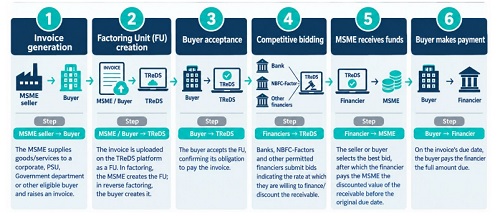
Trade Receivables Discounting System (TReDS) is an RBI-regulated electronic platform that enables MSMEs to obtain early payment against invoices raised on corporates, government departments and public-sector enterprises. Multiple financiers competitively bid to fund buyer-accepted invoices, with financing provided without recourse to the MSME seller.
How a TReDS Transaction Works
TReDS Financing Rises Over Four-Fold to Rs 3.5 Lakh crore in FY26 from FY23
TReDS ecosystem has expanded rapidly over the last few years, driven by increasing adoption among MSMEs, greater participation from corporates and financiers, and continued regulatory support for digital supply chain financing.
Table 1: TReDS Invoice Value, Platforms and Registrations, FY23 to YTD FY27 (Aug 26)


The TReDS ecosystem grew significantly between FY23 and FY26, reflecting increasing adoption of digital receivables financing among MSMEs and corporates.
The average ticket size of FUs financed stood at approximately Rs 21.8 lakh (based on the value-to-volume ratio of FUs financed) in FY26, indicating that TReDS is facilitating meaningful working-capital support across MSME transactions.
The expansion in transaction volumes has further been supported by the increase in the number of operational TReDS platforms from three in FY23 to five in FY26, enhancing market reach, improving participant access, and fostering greater competition and innovation within the ecosystem.
The ecosystem also continues to benefit from a widening buyer network. More registered buyers translate into a larger pool of invoices becoming eligible for discounting, thereby creating a positive network effect that enhances platform utilisation.
Regulatory initiatives promoting MSME financing, increasing onboarding of corporate and government entities, greater awareness among suppliers, and continued digitisation of financial workflows have contributed to the accelerated growth of the TReDS market. Recent policy measures mandating TReDS onboarding for eligible large corporates and CPSEs are expected to further expand transaction volumes and MSME participation in the coming years.
TReDS Funds 96% of Uploaded Invoice Value in FY26
TReDS financed 96% of the invoice value in FY26, reflecting strong financier appetite for factoring units on the platform. The high conversion rate, maintained alongside rapid growth in uploaded invoice value, highlights the strength, scalability and efficiency of the TReDS ecosystem.
On a platform-registration basis, as per RBI, banks accounted for approximately 73% of financier registrations, while NBFCs and other financial institutions represented the remaining 27%. These figures may include the same financier registered across multiple platforms. Moreover, the strong participation of banks provides depth and liquidity to the ecosystem, while the growing presence of NBFCs enhances competition, broadens funding availability, and supports financing access across a wider spectrum of MSME suppliers
Despite the strong growth witnessed in recent years, overall penetration remains relatively low. The five platforms reported a combined 2,95,529 seller registrations (may include duplications, as a seller might register on multiple platforms) as of Aug 26, which is equivalent to only around 0.30% of the 9.88 crore Udyam registrations (including UAP registrations) recorded as of Oct 26. This indicates significant untapped potential, with substantial scope for TReDS adoption to deepen as awareness, onboarding and participation increase across the ecosystem
Rs 8.1 Lakh Crore Stuck in Delayed MSME Payment Leaves Room for TReDS
The Economic Survey 25-26 estimates that approximately Rs 8.1 lakh crore remains locked in delayed payments to MSMEs, highlighting the significant working capital constraints faced by the sector and the need for efficient receivables financing mechanisms. This challenge is becoming increasingly relevant for corporate supply chains; based on the analysis of 1,656 non-financial-services companies’ consolidated financials sourced from Ace Equity, payables to MSMEs as a share of total trade payables increased from 2.6% in FY23 to 4.1% in FY26, indicating the growing significance of MSME suppliers within corporate payable structures.
TReDS has become an important source of MSME liquidity, allowing suppliers to convert buyer-approved invoices into immediate cash through a transparent, digital, collateral-free and without-recourse financing process. Supported by competitive bidding from banks and financial institutions, the platform helps improve cash flow certainty and reduce dependence on traditional credit channels for MSMEs.
Annual TReDS Financing Value Projected at Rs 8-10 Lakh Crore by FY30
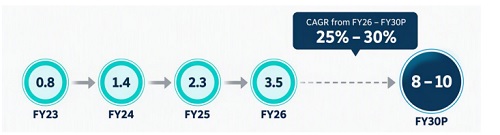
Annual TReDS financing is projected to reach Rs 8-10 lakh crore by FY30. The expansion is expected to be supported by wider participation from buyers and MSMEs, mandatory routing of CPSE invoices, increased flow of eligible invoices through TReDS, deeper liquidity from banks and NBFCs, and continued regulatory support. Together, these factors could strengthen TReDS’ role as a specialised receivable-financing channel that improves working-capital access and supply-chain efficiency.
This growth will take place within a broader expansion of formal credit to the MSME sector. Total MSME credit outstanding, estimated at approximately Rs 17 lakh crore as of FY26, is projected to grow at a CAGR of 20%-21% through FY30, driven by rising working-capital and investment requirements, greater credit formalisation, wider adoption of digital lending channels, improved access to institutional finance and continued policy support. Within this expanding credit ecosystem, TReDS is expected to complement conventional term loans and working-capital facilities by enabling MSMEs to unlock liquidity specifically against buyer-accepted trade receivables.
Above views are of the author and not of the website kindly read disclaimer