Commodity Insights Yearbook 2026 released at Global Commodity Conclave, charts India's path from price-taker to price-setter
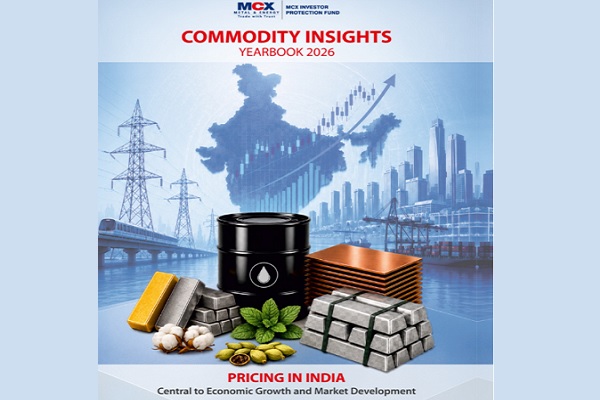
India's biggest gap in commodity markets is not scale, but pricing power. That is the central argument of the Commodity Insights Yearbook 2026, released at the Global Commodity Conclave (GCC) 2026, on the opening day of the three-day event in Mumbai.
Built around the theme "Pricing in India: Central to Economic Growth and Market Development," the Yearbook brings together perspectives from economists, market practitioners, industry leaders and subject-matter experts across institutions including KPMG, S&P Global Energy, Regsus and Metal Intelligence Centre, Alpha Alternatives, DSP Asset Managers, Aadishakti Group, Bandhan AMC, Exide Industries, IIM Calcutta, St. Xavier's University Kolkata, Quesrow Research & Strategy Co., Comm'fident and CRU Group. Its 13 contributions examine benchmark formation and the evolution of pricing across gold, steel, base metals, metal recycling, energy and agricultural commodities, alongside an extensive statistical section.
In her preface, Praveena Rai, MD & CEO, Multi Commodity Exchange of India Ltd. (MCX), places credible price discovery at the centre of India's economic development. She writes that as India advances towards Viksit Bharat 2047, the strength of its markets will be as important as the scale of its production and consumption. Prices, she notes, are signals that guide investment, resource allocation and production decisions, making an efficient and credible pricing ecosystem essential to sustained economic growth, competitive markets and long-term resilience.
The Yearbook argues that India now has an opportunity to build deeper domestic markets that better reflect its own economic fundamentals and strengthen its influence in global commodity pricing. It highlights the role of market institutions, infrastructure, broad-based participation and a trusted regulatory environment in building transparent and credible pricing mechanisms.
The broader ambition is to move beyond simply responding to prices established in international markets and strengthen India's ability to contribute to global price discovery. This is particularly relevant as India's production, consumption and trade in commodities continue to expand. The Yearbook notes that domestic prices are likely to become increasingly important indicators for Indian stakeholders and may play a larger role in regional trade decisions across Asia.
Above views are of the author and not of the website kindly read disclaimer