Dollar dips after Supreme Court rules against Trump`s tariffs
The dollar declined in volatile trading on Friday and was poised to snap a four-session streak of gains after the U.S. Supreme Court struck down President Donald Trump's sweeping tariffs based on a national emergency law.
The justices, in a 6-3 ruling authored by conservative Chief Justice John Roberts, upheld a lower court's decision that the Republican president's use of this 1977 law exceeded his authority.
The dollar was initially higher on the day after U.S. economic data showed a higher-than-anticipated inflation reading while economic growth fell well short of expectations.
The Commerce Department said gross domestic product increased at a 1.4% annualized rate last quarter, much lower than the 3% growth pace estimate of economists polled by Reuters. Analysts noted, however, that the number was negatively impacted by the government shutdown.
"The majority of this week has been dollar positive, except for right now, and why I'd say the 'sell America' trade got a little ahead of itself," said Erik Bregar, director of FX and precious metals risk management at Silver Gold Bull in Toronto.
"We have to see how Trump responds, how (Treasury Secretary Scott) Bessent responds, how the administration responds. We've heard all this talk that they have other ways of instituting these tariffs."
Trump said in a briefing after the ruling that he would sign an order to impose a 10% global tariff under Section 122 of the 1974 Trade Act and would initiate several other investigations as well, while Bessent said that estimates by the department show the use of section 122 authority, combined with potentially enhanced section 232 and section 301 tariffs will result in virtually unchanged tariff revenue in 2026.
Separately, the personal consumption expenditures price index, excluding the volatile food and energy components, rose 0.4%, the Commerce Department said, after an unrevised 0.2% gain in November and above the 0.3% estimate. It rose 3% in the 12 months through December after a 2.8% climb in November.
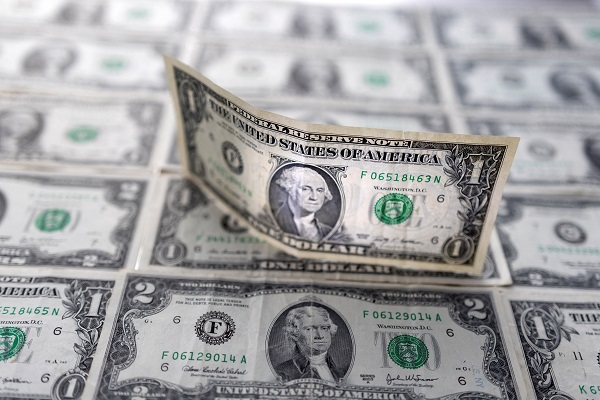
The dollar index, which measures the greenback against a basket of currencies, including the yen and the euro, shed 0.09% to 97.80, with the euro up 0.06% at $1.1779. The greenback is up nearly 1% on the week, on track for its biggest weekly gain since November.
A business survey showed euro zone activity accelerated faster than forecast this month as manufacturing swung back to growth for the first time since October, though the dominant services sector marginally underperformed expectations.
The court ruling also did not address the issue of the government refunding the tariffs which were struck down, an issue Trump said could take years in litigation.
"The biggest uncertainty was whether the court would address refunds, which they did not. That is going to be the big next fight, with many companies already preparing for litigation," said Tom Graff, chief investment officer at Facet in Phoenix, Maryland.
Analysts at Wells Fargo said in a note that the ruling was a "small net negative for USD, but probably not enough to change fundamental picture that favors tactical USD long bias."
Friday's data and the tariff ruling slightly dented market expectations the Federal Reserve could cut rates in the near term. Expectations for a cut of at least 25 basis points at the central bank's June meeting - the first pricing in more than a 50% chance of a cut - dipped to 53.8% from 58.6% a day earlier, according to CME's FedWatch Tool.
The dollar has been strengthening this week in part due to rising tensions between the U.S. and Iran. Trump said on Friday he was considering a limited military strike on Iran but gave no other details while Iran's foreign minister said he expected to have a draft counterproposal ready within days following nuclear talks this week.
Sterling strengthened 0.16% to $1.3484 but was down about 1.2% on the week, its biggest weekly decline since January 2025. British retail sales volumes rose in January at the fastest annual pace in nearly four years, according to official data, while a survey showed British businesses have extended their early 2026 rebound into a second month.
Against the Japanese yen, the dollar strengthened 0.06% to 155.08 and is up 1.6% on the week, its biggest weekly gain since October. Japanese data showed the country's annual core consumer inflation hit 2.0% in January, the slowest pace in two years.