How Periscope Camera Systems Work
Smartphone cameras have become increasingly powerful, but the thin design of modern phones creates a major challenge: there is only limited physical space for traditional camera lenses. Periscope camera systems help solve this problem by changing the way light travels through the phone, allowing smartphones to offer stronger optical zoom without requiring a very thick camera module.
What Is a Periscope Camera?
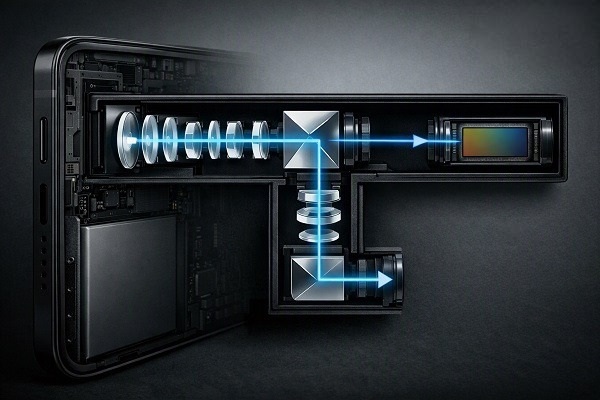
A periscope camera is a smartphone camera system that uses a sideways or folded optical path. Instead of sending light directly through a long lens toward the image sensor, the system uses a prism or mirror to redirect the light.
This allows the lens elements to extend horizontally inside the phone rather than requiring the entire optical system to sit vertically.
Why Smartphones Need This Technology
Traditional smartphone camera modules have limited room because phones are relatively thin. Higher optical zoom generally requires a longer focal length, which normally means a physically longer lens system.
A periscope design effectively folds that longer optical path into the available space inside the phone. This allows manufacturers to increase focal length while keeping the phone relatively slim.
How Light Travels Through a Periscope Camera
Light first enters the camera through the external lens opening. A small prism or mirror then redirects the incoming light, usually by roughly 90 degrees, into a lens assembly positioned horizontally inside the phone.
The light passes through multiple optical elements before reaching the image sensor. The sensor then converts the incoming light into electrical signals that are processed into a photograph.
Optical Zoom vs Digital Zoom
One of the biggest advantages of a periscope camera is optical zoom. Optical zoom changes the magnification by using the physical optics of the camera.
Digital zoom, on the other hand, enlarges part of an existing image using software. Extreme digital zoom can reduce detail and make photographs look softer.
Periscope cameras can provide a stronger optical foundation before computational photography is applied.
How Periscope Cameras Achieve High Zoom Levels
Manufacturers can use longer focal lengths and sophisticated lens arrangements to produce greater magnification. Some systems also use moving lens elements to provide variable optical zoom, while others use fixed telephoto cameras combined with computational techniques.
The exact zoom range depends on the camera design, sensor size, lens configuration, and software processing.
The Role of the Prism
The prism is one of the defining components of many periscope designs. Its job is to change the direction of incoming light so that the optical system can occupy horizontal space.
Precise optical alignment is important because even small errors can affect image quality, focusing, and stabilization.
Image Stabilization Is Especially Important
Higher magnification also makes camera shake much more noticeable. A tiny movement of the phone can become a significant movement in the captured image when using a long focal length.
For this reason, advanced telephoto and periscope systems often use optical image stabilization or other stabilization technologies to compensate for movement.
Periscope Cameras and Low-Light Photography
Longer zoom lenses can sometimes receive less light than a phone's main camera, depending on the lens and sensor design. This can make telephoto photography more challenging in darker environments.
Modern smartphones compensate with larger sensors, wider apertures where possible, multi-frame processing, noise reduction, and image-combining techniques.
Computational Photography Still Matters
A periscope camera does not work alone. Smartphone software can combine optical information with computational processing to improve sharpness, exposure, color, and detail.
At certain zoom levels, the phone may also combine information from multiple cameras rather than relying entirely on one sensor.
Advantages and Limitations
Periscope cameras make high-quality long-range photography possible on relatively thin smartphones. They are particularly useful for photographing distant subjects, landscapes, architecture, sports, and other scenes where getting physically closer is difficult.
However, these systems can be more complicated and expensive to manufacture. Their performance can also vary significantly between phones because sensor size, lens quality, stabilization, and software processing all matter.
Conclusion
Periscope camera systems are essentially a clever solution to a physical-space problem. By bending the path of light and placing the lens system horizontally inside the phone, manufacturers can achieve longer focal lengths and stronger optical zoom capabilities without making smartphones dramatically thicker. Combined with stabilization and computational photography, this technology has made long-range smartphone photography increasingly capable.