Market Outlook for October 2026 by ICICI Prudential Alternates

In Sep’26, the Indian equity markets came under significant pressure, with the Nifty 50 declining by 6.1%, as escalating West Asia tensions, elevated crude oil prices and rising global bond yields along with FPI selling weighed on the market’s performance. However, easing crude prices towards the month-end and selective value buying provided some relief, with domestic institutional flows continuing to cushion the broader market.
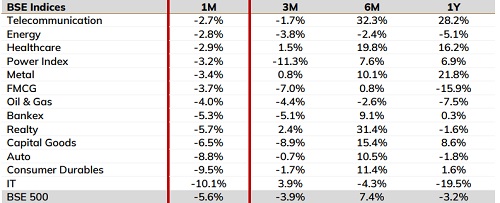
Market breadth weakened considerably during the month, with the Nifty Midcap 150 and Nifty Smallcap 250 indices declining by approximately 7.1% and 3.1% respectively. During the month, BSE Telecommunication, BSE Energy and BSE Healthcare indices emerged as the least impacted sectors recording performance of -2.7%, -2.8%, and -2.9% respectively. Among the top laggards for the month were BSE IT, BSE Consumer Durables, and BSE Auto, clocking -10.1%, -9.5%, and -8.8% respectively.
Foreign Portfolio Investors (FPIs) turned strong net sellers in Sep’26 (until 29 Sep’26), withdrawing approximately USD 4.1 bn from Indian equities in the secondary market, reversing the buying seen during Jul’26 and Aug’26. In contrast, Domestic Institutional Investors (DIIs) remained strong net buyers, purchasing approximately USD 8 bn of Indian equities during the month (until 30 Sep’26), extending their streak of monthly net buying and providing liquidity cushion amid heavy FPI selling. Further, the primary market activity remained strong despite weak secondary market conditions, with 32 IPOs raising USD 4.1 bn during the month of Sep’26.
India’s deficit widens and inflation edges up
On the macroeconomic front, Gross GST receipts collected in Sep’26 stood at INR 2tn, up 7.7% YoY, similar to that in the previous two months. On the other hand, the fiscal deficit widened to INR 7.1tn in April-August 2026, up from INR 6.0tn a year earlier, reaching 41.9% of the full-year target, compared with 38.1% previously. India’s manufacturing activity rebounded in Sep’26, with the Manufacturing Purchasing Managers Index (PMI) rising to 55.1 from 52.8 the previous month, signaling accelerated growth momentum. New orders and output both increased, supported by healthy domestic and overseas demand, and employment growth resumed after contracting last month. However, India's weakest monsoon in over a decade, ending Sep’26 with a 12.6% rainfall deficit, raised significant concerns about agricultural output, rural incomes, food inflation, and water availability. The Consumer Price Index (CPI) rose to 4.8% YoY in Aug’26 from 4.5% in Jul’26.
As inflationary pressures persist and the economy gradually transitions towards a structurally higher inflation and interest-rate environment, our portfolio positioning aims to adapt accordingly. In such an environment, businesses with stronger near-term cash flows are likely to be better positioned than those with distant cash flows realizations, as higher discount rates can exert greater pressure on valuations. At the same time, companies with excessive leverage may face heightened balance sheet risks as funding costs rise. Consequently, portfolios may benefit from a tilt towards value over growth, with a preference for businesses characterized by strong cash generation, prudent capital structures and durable balance sheets.
While Government capex has remained healthy, Private Capex announcements have picked up pace
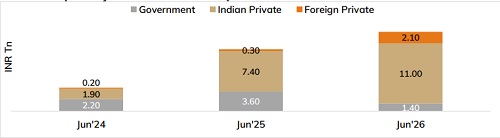
Within the government sector, the Centre’s capex recorded healthy growth in Q1FY27 while States’ capex growth was muted. Despite a high base, the Centre’s capex was up 17.8% YoY, while States’ capex increased 6.6% in Q1FY27. Consequently, government capex (Centre + States) was 4% of GDP in Q1FY27, lower than ~5% of GDP in the last few years but still comparable to that in Q1 of last financial year.
The capex space has overall seen a pickup in the new project announcements by ~29% (YoY) to INR 14.6 tn in Q1FY27. This surge is majorly led by private sector, both Indian and Foreign companies. While the government capex announcements declined by 61%, foreign private companies (by ownership) led the project announcements by 600%.
Exhibit 1: Capex Project announcements in Q1
Markets since the peak of Sep’24
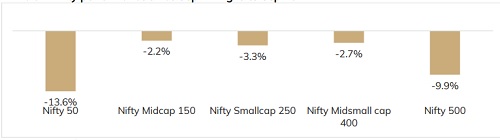
After hitting an all-time high in Sep’24, the Indian equity markets entered a prolonged consolidation phase marked by both time and price correction. Persistent global, geopolitical and macroeconomic uncertainties have amplified volatility across global and domestic markets, pulling the Nifty-50 down by ~14% from its 2024 peak, even as the impact on mid and small-cap indices (SMID) has been limited.
Sectoral rotation towards pockets dominated by mid and smallcaps enabled SMIDs to outperform, softening the impact of a sharper drawdown in largecaps and thereby containing overall index weakness. Strength in several new-economy and emerging sectors boosted SMID performance, even as the shift away from mature largecap segments triggered significant underperformance among conventional sectors and stocks.
Exhibit 2: Nifty performance since Sep’24 highs to Sep’26
The ongoing market consolidation, coupled with a steady earnings recovery from FY25 lows, has driven a meaningful moderation in valuations from the elevated levels of Sep’24. Large and midcap segments saw the sharpest resets, with valuations declining ~21% and 37% from their respective highs, while the Nifty Smallcap 250 index is still at a premium of 8.5% and the Nifty Midsmallcap 400 index saw a 22% correction.
Exhibit 3: Despite valuation corrections, earnings have been resilient
Going ahead
The Indian markets, while supported by the domestic resilience, remain closely tied to evolving external risks. The sharp corrections in Sep’26 reflect a confluence of external pressures, heavier FPI outflows, higher crude prices, firm global bond yields and uncertainty around West Asia. Any renewed escalation in West Asia, monsoon linked inflation outcomes and the RBI’s policy remain monitorable and could further extend volatility.
With domestic liquidity seemingly supportive and economic activity appearing firm, we expect markets to remain increasingly earnings-centric. As macro conditions are evolving and external variables remain fluid, portfolios anchored in robust bottom-up conviction and disciplined stock-picking could likely perform well. In our view, the ability to identify companies with durable earnings visibility and strong execution will matter more than ever in shaping overall returns.
Above views are of the author and not of the website kindly read disclaimer











More News
Nifty Slips as Weakness Persists Below 22,600 - GEPL Capital Ltd