Navigator Report September 2026 by DSP Mutual Fund

What Are We Saying: Buy Stocks
1. Large caps are becoming attractive again. The Nifty has remained range-bound while earnings have continued to grow. Trailing P/E is now close to 19.5x, between long-term average and fair value. Q2FY27 earnings could take trailing valuations below 19x. This is a reasonable zone to add large caps, including through lump-sum allocations.
2. SMIDs still lack a margin of safety. Activity and valuations across the broader small- and mid-cap universe remain buoyant. Even 20%+ earnings growth does not comfortably justify broad trailing valuations of 30–40x. Be selective. Stagger allocations. Avoid large lump-sum commitments to the segment at current valuations.
3. There is little reason to change the bond stance. Government bond yields have risen with the ebb and flow of oil-related concerns. But domestic inflation remains contained, government borrowing is under control and balance-of-payments pressure is not extraordinary. The underlying case for holding G-Secs remains intact. There is little need for tactical action.
4. Precious metals still lack a margin of safety. Gold and silver have moved sideways without establishing a clear trend. At current prices, neither offers an obvious asymmetry. Silver looks more vulnerable, given weak incremental investment demand and rising scrap supply. A meaningful drawdown would improve the risk-reward for patient investors.
5. The conclusion is deliberately uneventful. Large caps offer opportunities, with some stocks approaching genuinely attractive valuations. Outside this pocket, there is little reason to become aggressive.
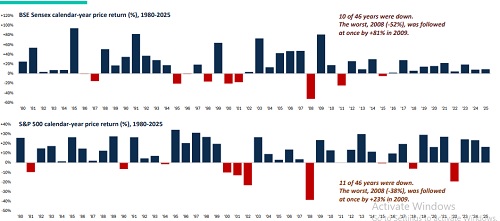
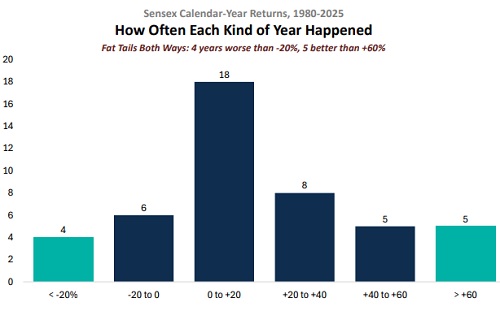
Forecasts naturally lean towards what history suggests is the more likely outcome. And history does help — some outcomes have clearly occurred more often than others. But the most frequent outcome is not the only possible outcome.
An investor experiences the return that actually occurs in that year. It could lie in the most common range, but it could just as easily be a year of sharp losses or unusually large gains.
This is what a point forecast can miss. It tells us where the outcome may be centred, but not necessarily the outcome an investor will live through. The less frequent outcomes matter precisely because, when they arrive, they become the investor’s entire experience for that year.
Forecasting therefore needs room for the tails — not because they are the most likely, but because they are possible.
Above views are of the author and not of the website kindly read disclaimer
















More News

Quote on Sensex 30th September 2026 by Sachin Gupta, VP ? Technical Research at Choice Equit...