
PL Wealth Sees Opportunities in Indian Equities Amid Market Recovery, Recommends Staggered Investments and High-Quality Debts

PL Wealth Management’s latest Market Outlook & Investment Strategy – November 2026 highlights improving sentiment in Indian equity markets, supported by a return of foreign portfolio investor (FPI) inflows, resilient corporate earnings and sustained domestic investor participation. While the Nifty has gained nearly 10% since the October close, concerns around elevated inflation, global interest rates, food prices and geopolitical developments warrant a measured investment approach. PL Wealth recommends maintaining a constructive stance on equities, with a preference for large-cap and flexi-cap strategies, staggered exposure to mid- and small-cap stocks, and high-quality short-duration fixed-income investments.
India’s economic growth remains resilient with GDP growing 7.8% in Q1 FY27 compared to the full-year growth projection of 7.1% by the Reserve Bank of India. The big macro worry now, however, is inflation, with Consumer Price Index (CPI) inflation rising to 6.09% in October 2026, above the RBI’s upper tolerance limit of 6%. Food inflation too climbed to 8.94% from 7.74% in September. The monsoon deficit at 12.6% and the likely El Nino induced disruptions may add to food price pressures. Movement in crude oil and currency continue to remain other important factors influencing the inflation outlook.
On October 6, the RBI raised the repo rate by 25 basis points to 5.50% while adopting a calibrated tightening stance. “Given ongoing inflation pressures, we believe monetary policy may remain restrictive for longer, and further rate adjustments may be made depending on incoming inflation and growth data,” PL Wealth said. Meanwhile, the yield on the 10-year government security stood at about 7.22 percent as of November 12, down from 7.41 percent at the end of October.
Speaking on the outlook, Inderbir Jolly, CEO, PL Wealth, said: “The return of foreign investor flows and the recent bounce in Indian equities is encouraging. But we believe that the sustainability of this recovery will depend on wider market participation, earnings growth and the continuation of institutional inflows. Global interest rate uncertainty and inflationary pressures continue to weigh on market sentiment and investors should avoid chasing short term rallies and focus on quality businesses, disciplined asset allocation and staggered investments. “We are still constructive on
India, but portfolio positioning and valuations will be key to navigating the next few months.”
Equity Markets: Recovery Gains Momentum, but Selectivity Remains Key
Indian equity markets witnessed a sharp improvement in November following a relatively subdued October, when the Nifty 50 gained 1.91%, while the Nifty Midcap 100 and Nifty Smallcap 100 declined by 3.42% and 4.06%, respectively. The Nifty subsequently rallied to 25,299 on November 12, registering a gain of approximately 9.7% from the October closing level.
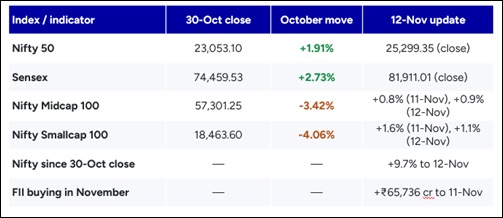
Foreign investor activity also turned sharply negative. Having sold shares worth ?45,162 crore in October, foreign institutional investors (FIIs) turned buyers in November with net purchases of ?65,736 crore in seven trading sessions till November 11. Meanwhile, domestic institutional investors (DIIs) continued to support the market with net buying of ?62,220 crore in October. Domestic participation is still structurally strong with monthly SIP contributions at ?32,160 crore in October with 9.99 crore contributing accounts.
There have been encouraging signs in corporate earnings as well. The interim results for the September 2026 quarter for 230 companies (excluding oil marketing companies) show profits growth of 30% for large-cap companies, 26% for mid-cap companies and 34% for small-cap companies. Some 43% of companies exceeded expectations, compared to 24% that fell short, and profit increased in 29 out of 32 sectors. But the broader market remains mixed, highlighting the need for earnings visibility and valuation discipline.
On valuations, Nifty was trading at around 17.3 times one-year forward earnings at end October, compared with its 10-year average of 18.7 times. But since the November rally, valuations have returned closer to their historical averages. Mid-cap stocks are trading at around 26 times trailing earnings and small-cap stocks at about 34 times. Investors should ssbe cautious about aggressive allocations.
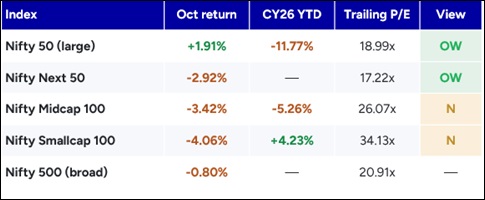
PL Wealth maintains an overweight view on Indian large-cap and flexi-cap strategies, recommending phased deployment of investments, with an indicative 50% allocation upfront and the remaining through systematic transfer plans (STPs) over three to six months. For mid- and small-cap strategies, the preference is to build exposure gradually through SIPs and STPs over six to twelve months rather than making concentrated lump-sum investments. Banks and financial services, IT, pharmaceuticals, healthcare, power and utilities, and manufacturing remain preferred sectors, backed by earnings visibility and structural growth opportunities.
Fixed Income: High-Quality Accrual Strategies Take Priority
In the fixed-income segment, PL Wealth continues to favour high-quality accrual-oriented strategies, particularly in the one-to-three-year maturity segment, amid uncertainty around inflation and the RBI's future policy actions.
The 10-year government security yield eased to approximately 7.22% as of November 12, compared with 7.41% at the end of October. However, the possibility of further monetary tightening and persistent inflationary pressures could create volatility in longer-duration instruments.
PL Wealth recommends maintaining an overweight allocation to high-grade one-to-three-year debt strategies, including Banking and PSU funds, to capture relatively stable accrual opportunities while managing interest-rate sensitivity. Selective exposure to three-to-five-year AAA-rated corporate bonds may also be considered after evaluating prevailing market yields and issuer quality. Longer-duration government securities remain underweight until there is greater clarity on inflation trends and the RBI's policy trajectory. Money-market funds can also serve as a source of liquidity for investors planning staggered equity investments.
Commodities: Gold Remains a Strategic Hedge, Silver Calls for Caution
Gold and silver continue to play an important role in portfolio diversification, although both remain sensitive to movements in global interest rates, the US dollar and geopolitical developments.
Spot gold stood at approximately US$4,034 per ounce on November 11, following a decline of around 2.5% on November 10 amid stronger-than-expected US inflation data. Structural demand remains supportive, with central banks purchasing 321 tonnes of gold in Q3 2026, representing a 42% increase year-on-year. Global gold ETFs also recorded inflows of 211 tonnes during the quarter.
Silver was trading at approximately US$52.67 per ounce on November 11. While industrial demand and persistent supply deficits provide underlying support, its relatively higher volatility warrants a measured allocation.
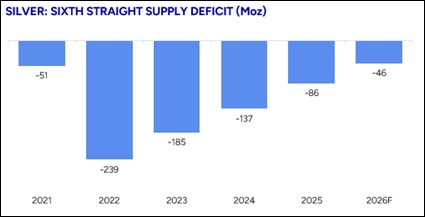
PL Wealth views gold as the core precious-metal hedge and silver as a smaller satellite allocation. It recommends maintaining a combined allocation of approximately 5–10% to gold and silver, with investments added in tranches rather than chasing sharp price movements.
Portfolio Strategy: Diversification and Disciplined Allocation
PL Wealth's November outlook emphasises the importance of aligning portfolio allocations with individual investment horizons and risk profiles. Alongside a preference for Indian large-cap and flexi-cap equities, the firm recommends diversified international equity exposure of approximately 5–10% of the equity portfolio to manage geographic and currency concentration risks.
Investors may also consider alternative investment strategies, including Portfolio Management Services (PMS), Specialised Investment Funds (SIFs), Alternative Investment Funds (AIFs), REITs and InvITs, subject to eligibility, liquidity requirements and individual suitability.
The broader investment strategy remains constructive but selective. While returning foreign investor flows, resilient earnings and strong domestic savings provide support to Indian markets, elevated inflation, potential monetary tightening and valuation concerns warrant disciplined capital deployment. PL Wealth believes that investors should remain invested, prioritise quality, diversify across asset classes and periodically rebalance portfolios rather than react to short-term market movements.
Above views are of the author and not of the website kindly read disclaimer









Tag News
Market Round-up 18th November 2026 by Motilal Oswal Wealth Management Ltd