What happens to forward returns when Nifty breaches P/B of 2.8? Lessons from 10 breaches across 8 market-stress episodes since 1999

NIFTY Could Cross 39,600 in Three Years and 42,800 in Five Years: OmniScience Capital
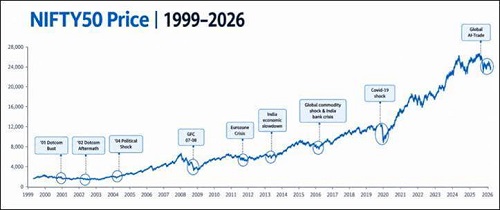
According to a new analysis by OmniScience Capital, the NIFTY’s recent breach of 2.8x P/B multiple is better viewed in the context of historical valuation cycles. Eight distinct episodes of market stress were identified, excluding the current episode, in which the NIFTY’s P/B breached 2.8x and remained below that threshold for at least 90 days. This amounts to roughly one episode every three years over the past 27 years.
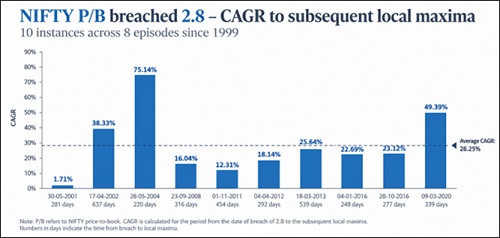
Across these episodes, ten individual breaches were identified, as some prolonged periods of market stress included more than one qualifying breach. The NIFTY generated an average CAGR of 28.25% between the initial breach of 2.8x P/B and the subsequent local price maximum. Across the ten instances identified, the market took an average of 360 days to reach the subsequent local price maxima from the date of breaching 2.8x P/B, with an average holding-period return of 27.85%. Individual CAGRs ranged from 1.71% to 75.14%. The analysis also examined 3 & 5 year returns from the initial breach dates. Across the ten instances, average 3 & 5 year CAGRs were 15.91% and 16.02%, respectively, compared with full-period median rolling returns of 11.98% and 12.17%.
This suggests that investing during periods of valuation stress has historically offered the potential for returns above typical market outcomes.
Fundamentals and valuation rerating underpin return estimates
OmniScience Capital’s forward-return framework combines expected earnings growth, potential valuation rerating and a median dividend yield of 1.30%. Under the base and best-case scenarios, this implies estimated annualised total returns of 21.0%–24.0% over three years and 17.1%–18.9% over five years.
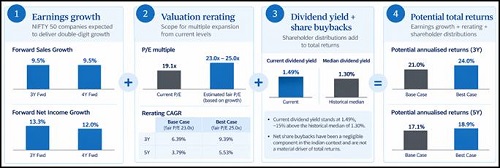
From a current NIFTY level of approximately 22,800, these assumptions imply index levels of around 39,600 in three years and 42,800 in five years under the base case, and 43,000 and 46,500, respectively, under the best case.
“These are not predictions of where the NIFTY will trade, but mathematical outcomes based on fundamentals, reasonable earnings growth assumptions and potential valuation rerating. A doubling of the index may sound ambitious, but over five years it translates to an annualised return of approximately 15%. Our objective is not to predict the market, but to quantify what reasonable assumptions about earnings and valuations could imply for long-term returns,” said Vikas Gupta, CEO and Chief Investment Strategist, OmniScience Capital.
Above views are of the author and not of the website kindly read disclaimer










Tag News

Daily Stock Derivative Lens - 23rd October 2026 by Axis securities